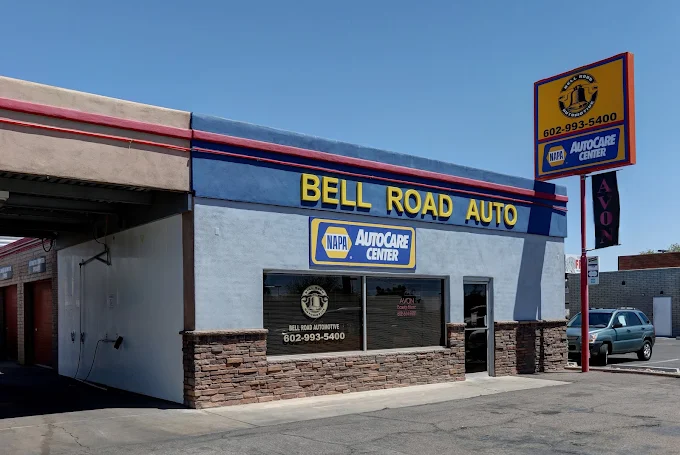
Meet Us In Person
Come see the shop before you need it
Stop in, meet Andy and Reinette, and get a straight answer about what your vehicle actually needs. No pressure and no sales script waiting at the counter.
From The Bays
The same questions come across the counter every week. Andy has been answering them in writing for years, so here they are: what fails in Arizona heat, what the noises mean, and what genuinely needs fixing now.
Every Article
Electrical
A battery rarely dies without warning. It spends weeks dropping hints through the dashboard, the door locks and the way the engine turns over on a cool morning.
Read ItCooling and AC
A cooling fault that hides on a mild March morning will find you in July traffic on the I-17. Here is how the system fails, in the order it usually fails.
Read ItDiagnostics
Forty degrees of temperature change between sunrise and lunch does something to the air your engine is measuring. Your sensors notice, even when you do not.
Read ItTires and Alignment
When the shaking starts is more useful than that it is shaking at all. At 60 mph it means one thing. Only under braking, it means something else entirely.
Read ItCooling and AC
In most of the country a broken car air conditioner is an inconvenience. In the Valley it is closer to a safety system, and it fails on a predictable schedule.
Read ItBrakes and Suspension
Everybody checks the coolant before summer. Almost nobody checks the fluid that makes parking possible, and dry desert air is unusually hard on it.
Read ItBrakes and Suspension
Every stop you make is a small controlled act of destruction, and the brake pad is the part being destroyed. Knowing how much is left is a measurement, not a guess.
Read ItMaintenance
One rubber loop drives nearly everything bolted to the front of your engine. It gives very little notice, and a Phoenix summer ages it faster than the calendar does.
Read ItSeasonal Driving
Summer here does not just make driving unpleasant. It quietly degrades five specific things on your car, and fall is when the bill for that usually arrives.
Read ItTires and Alignment
Asphalt in a Phoenix July runs far hotter than the air above it, and your tires are the only part of the car that has to touch it.
Read ItDiagnostics
Your nose is a better diagnostic tool than most drivers give it credit for. Four distinct smells, four different systems, four very different levels of urgency.
Read ItDiagnostics
Not every light on the dash carries the same weight. Some are a reminder. One or two mean the next ten miles decide whether this is a repair or a replacement.
Read ItDiagnostics
The light means a system reported a measurement outside its expected range. That is genuinely all it means, which is why the code is where diagnosis begins.
Read ItCooling and AC
Pleasant weather is a poor reason to relax about the cooling system. Spring is precisely when the hoses that survived last summer start showing what it cost them.
Read ItSeasonal Driving
Everyone worries about the clear coat. Meanwhile the rubber holding weather, dust and monsoon rain out of your interior is quietly turning brittle.
Read ItMaintenance
Injectors fail by degrees rather than all at once, which is why the loss of fuel economy sneaks up on you a tank at a time.
Read ItBrakes and Suspension
Steering is the one system where you feel a fault through your hands before any warning light appears. Knowing what you are feeling is most of the work.
Read ItMaintenance
It is the cheapest thing on the service schedule and the one most likely to be stretched. Here is what each skipped interval is quietly buying you.
Read ItElectrical
Cold weather is when a weak battery finally quits. Arizona heat is what made it weak, and that happens in July rather than January.
Read ItMaintenance
Most expensive repairs start life as an inexpensive maintenance item somebody put off. These are the five that turn into real money the fastest.
Read ItBrakes and Suspension
Suspension wear is sneaky because you adjust to it. The ride gets worse slowly enough that the tires usually complain before you do.
Read ItTires and Alignment
A wheel out of balance by a fraction of an ounce spins hundreds of times a minute. Small errors do not stay small at seventy miles an hour.
Read ItSeasonal Driving
The interval printed in your manual assumes conditions most Phoenix drivers never actually see. Heat is the variable that quietly rewrites it.
Read ItCooling and AC
Air conditioning is a sealed system. That single fact explains why an annual top-up is a symptom rather than a maintenance routine.
Read ItCooling and AC
There is a short window each year when getting the cooling system looked at is convenient rather than urgent. It closes around the first hot week.
Read ItSeasonal Driving
Spring in the Valley is short and it is the last comfortable chance to get ahead of what summer does to a vehicle. Eight things, in the order they matter.
Read ItDiagnostics
You know your car's normal soundtrack better than any technician does. The useful skill is naming the thing that interrupted it.
Read ItSeasonal Driving
The drive from Phoenix to the high country changes elevation, temperature and road surface in under two hours. Worth a look under the hood before you go.
Read ItMeet Us In Person
Stop in, meet Andy and Reinette, and get a straight answer about what your vehicle actually needs. No pressure and no sales script waiting at the counter.